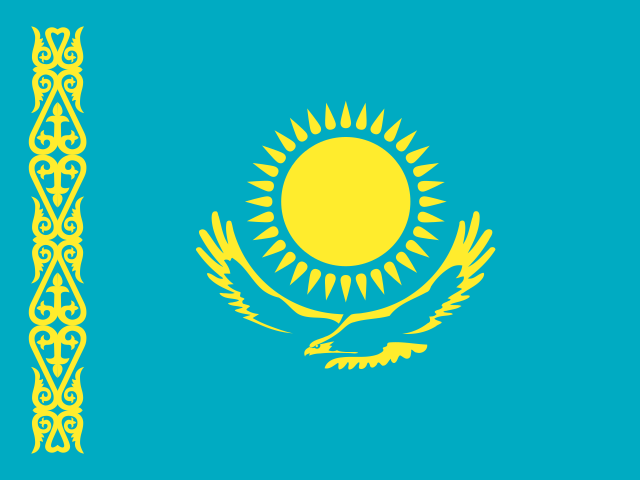
Kasachstan: Netzabdeckung
51
Mbps typisch
12
Mbps zu Stoßzeiten
2
verfügbare Netze
Welches Netz du bekommst
| Netz | Rolle | 5G |
|---|---|---|
| Kcell | Primär, standardmäßig genutzt | ja, non standalone |
| Beeline | Ausweichnetz, greift wenn das primäre schwächelt | ja, non standalone |
Du wählst nicht zwischen ihnen. Wenn das Netz, in dem du hängst, überlastet ist, schieben wir dich automatisch ins andere, mitten auf der Reise, und sagen es dir danach.
Über diese Werte
Die Geschwindigkeitswerte auf dieser Seite zeigen die typische Downloadgeschwindigkeit und die Geschwindigkeit, wenn das Netz voll ist, für das ganze Land und für die wichtigsten Städte.
Was die Zahlen zu Kasachstan bedeuten
Zwei Zahlen zählen, und nur eine davon zitiert jeder Anbieter. Die typische Geschwindigkeit, 51 Mbit/s, sagt Ihnen, wie ein guter Moment aussieht.
Das zehnte Perzentil, 12 Mbit/s, ist die Zahl, die sich zu lesen lohnt. Es ist das Tempo im schlechtesten Zehntel des Tages, wenn die Zelle über dem Bahnhof voll ist und alle um Sie herum ebenfalls darin sind. Ein Land mit hohem Median und niedrigem Boden funktioniert wunderbar, bis zu dem Moment, in dem Sie es wirklich brauchen.
Wenn die Reise von Videoanrufen oder Hotspot abhängt, planen Sie mit dem Wert für volle Zeiten und nicht mit dem typischen.
Was in Kasachstan passiert, wenn das Netz voll ist
Überlastung ist kein Fehler, sondern ein Dienstagabend. Die Frage ist, was Ihre eSIM dagegen tun kann, und bei den meisten Reise-eSIMs lautet die Antwort: nichts. Ein Großhandelsvertrag pro Land, ein Netz, und kein Ausweg außer, auf der Straße stehend, eine zweite eSIM bei jemand anderem zu kaufen.
Hier läuft der Orbislo-Verkehr über Kcell und Beeline. Wenn das Netz, in dem Sie sind, schlechter wird, holen wir Sie mitten auf der Reise in ein anderes, ohne dass Sie fragen, und sagen es Ihnen hinterher, statt Sie im Moment zu unterbrechen.
Kasachstan: Mobilfunkanbieter
- Kcell: Kcell, which sells under the Kcell and activ brands, grew its subscriber base by 8.8 percent to 8.67 million in 2025. Mobile data use rose 66.6 percent to 1,439 petabytes, an average of 21.5 GB per user each month.
- Kcell coverage: At the end of 2025 Kcell's 3G reached 93.89 percent of Kazakhstan's population, its 4G 86.01 percent and its 5G 53.54 percent. During 2025 it built 965 base stations that brought 4G to 592 more villages.
- Kcell ownership: The national operator Kazakhtelecom owns 51 percent of Kcell. After Kazakhtelecom sold Tele2 and Altel in January 2025, its chairman said the deal separated the three mobile operators, Tele2/Altel, Kcell and Beeline, from each other to create a competitive market.
- Beeline: Beeline Kazakhstan, majority owned by VEON, had 11.7 million mobile subscribers in the first quarter of 2026, 0.8 percent more than a year earlier, of whom 8.7 million used 4G.
- Beeline licence: Beeline's network is run by KaR-Tel, which holds state licence DS 0000317 issued on 24 August 1998 by the Ministry of Transport and Communications.
- Tele2 and Altel: Qatar's Power International Holding bought 100 percent of Mobile Telecom-Service, the company behind the Tele2 and Altel brands, from Kazakhtelecom in January 2025, completing an agreement signed in Doha on 14 February 2024.
- Tele2 and Altel, 5G users: In October 2025 Tele2/Altel told a government meeting it had more than three million active 5G users and carried more than half of Kazakhstan's mobile internet traffic, and set a target of six million 5G users by 2030 with over 400 billion tenge of investment.
Kasachstan: ältere Netze
- Tele2/Altel refarmed its 3G spectrum to 4G city by city in 2024: Almaty in March, then Shymkent from 16 September, Kyzylorda, Aktau, Atyrau, and Uralsk and Aktobe from 14 October. The change did not touch 2G, so basic push button phones kept working.
- By May 2025 Tele2/Altel had moved entirely to 4G spectrum in Almaty, Shymkent, Kyzylorda, Aktau, Atyrau, Uralsk, Aktobe, Karaganda, Temirtau, Akkol, Kostanay, Taraz, Semey and Ust-Kamenogorsk, so a phone relying on 3G for data finds none on that network there.
- Tele2/Altel said in November 2025 that it would give up its remaining 3G frequencies in favour of 4G, after upgrading 2,000 sites and activating more than 700 new ones.
- Tele2/Altel was the first Kazakh operator to launch VoLTE commercially, and by May 2025 more than 35 percent of its voice traffic ran over it. The operator says VoLTE is what allows it to switch off 3G by moving voice calls onto 4G.
- VoLTE calls on Tele2/Altel need 4G coverage and a smartphone certified for VoLTE on its network.
Kasachstan: 5G
- Kazakhstan auctioned its first 5G spectrum on 22 and 23 December 2022: 3600 to 3700 MHz and 3700 to 3800 MHz, each starting at 1.76 billion tenge. The lots sold for 62.7 billion and 93.4 billion tenge, both to a consortium of Kcell and Mobile Telecom-Service.
- Beeline's operator KaR-Tel and Freedom Telecom both lost the 2022 5G auction, so Beeline holds none of the 3600 to 3800 MHz spectrum sold then. In October 2023 a Kcell executive said a presidential instruction required Kcell and Tele2 each to deploy about 3,500 5G base stations by 2025, although the auction terms had set the end of 2027.
- Kcell launched commercial 5G on 12 March 2023 in Almaty and on 15 March 2023 in Shymkent, using the 3700 to 3800 MHz band, and in October 2024 became the first Kazakh operator to bring 5G into metro stations.
- By the end of 2025 Kcell ran 1,762 5G base stations, 818 of them under a network sharing agreement, covering 2,586 locations. About one in three devices on its network, 34.6 percent, supported 5G.
- In March 2025 Tele2/Altel demonstrated standalone 5G, which runs without a 4G anchor, on a single millimetre wave antenna on its Almaty technical office, and said wide use would likely come in 2027 to 2028.
Kasachstan: Hinweise zum Netz
- Tele2/Altel presented Voice over Wi-Fi in March 2025, letting certified smartphones make ordinary calls over Wi-Fi even in airplane mode. The operator aimed it at roaming users and at underground car parks and basements its signal does not reach.
- Beeline Kazakhstan tested Starlink Direct to Cell in Akmola region, sending SMS and making a WhatsApp call from an ordinary 4G phone on a Beeline SIM via satellite. It plans SMS for customers from 2026, subject to regulatory approval, to fill gaps in the mountains and steppe.
- Kazakhtelecom and AzerTelecom are building a 380 km fibre cable along the Caspian seabed from Aktau to Sumgait in Azerbaijan, designed for up to 400 terabits per second, as part of the Digital Silk Way corridor between Europe and Asia.
- The Trans-Caspian cable reached Kazakhstan's coast on 5 August 2026, completing the marine stage. It gives the country an alternative international data route, with shore connection, commissioning and testing expected in autumn 2026.
- Tele2 and Altel customers have mobile internet underground in the Almaty metro: by August 2025 service was live at 8 of the 11 stations, with work under way at the other three.
Kasachstan: Fragen und Antworten
In welchem Netz bin ich in Kasachstan?
Wie schnell sind die Daten wirklich?
Kann ich einen Laptop per Hotspot verbinden?
Schwankt die Geschwindigkeit innerhalb von Kasachstan?
Was, wenn ich in Kasachstan gar kein Netz bekomme?
Funktioniert mein Handy in Kasachstan?
Abdeckung in der Nähe
So schneidet Kazakhstan in Asien ab
- Typische Geschwindigkeit der Region
- 42.95 Mbps
- Genutzte Netze
- 2, Kcell, Beeline
- 5G
- Yes, non standalone
- Schnelleres Nachbarziel
- Thailand, 52 Mbps
- Langsameres Nachbarziel
- Maldives, 47 Mbps
- Städte mit eigener Seite
- 2: Almaty, Astana
Nahe Reiseziele in Asien
- Japan
- Japan, 74 Mbps, 2 Netze
- Malaysia
- Malaysia, 61 Mbps, 2 Netze
- Brunei
- Brunei, 58 Mbps, 2 Netze
- Vietnam
- Vietnam, 56 Mbps, 2 Netze
- Thailand
- Thailand, 52 Mbps, 2 Netze
- Maldives
- Maldives, 47 Mbps, 2 Netze
- India
- India, 46 Mbps, 2 Netze
- Tajikistan
- Tajikistan, 43.9 Mbps, 4 Netze
- Cambodia
- Cambodia, 42 Mbps, 2 Netze
- China
- China, 41 Mbps, 2 Netze