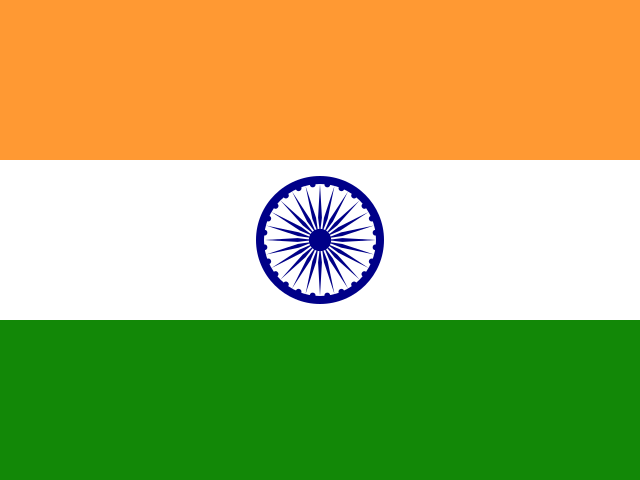
Cobertura de India
46
Mbps habituales
9
Mbps en hora punta
2
redes disponibles
Qué red te toca
| Operador | Función | 5G |
|---|---|---|
| Jio | Principal, la que se usa por defecto | sí, standalone |
| Airtel | Respaldo, se usa cuando la principal empeora | sí, standalone |
Tú no eliges entre ellas. Si la red en la que estás se satura, te pasamos a la otra automáticamente, en mitad del viaje, y te lo contamos después.
Sobre estas cifras
Las cifras de velocidad de esta página muestran la velocidad de descarga habitual y la velocidad cuando la red está cargada, para el país en conjunto y para sus ciudades principales.
Qué significan las cifras de India
Importan dos números y solo uno es el que cita todo el mundo. La velocidad habitual, 46 Mbps, te dice cómo es un buen momento.
El percentil diez, 9 Mbps, es el que conviene leer. Es la velocidad en la peor décima parte del día, cuando la antena de encima de la estación está llena y todos los que te rodean están en ella. Un país con mediana alta y suelo bajo es un país que funciona de maravilla hasta el momento en que de verdad lo necesitas.
Si el viaje depende de videollamadas o de compartir conexión, planifica con la cifra de hora punta y no con la habitual.
Qué pasa en India cuando la red se satura
La congestión no es una avería, es un martes por la tarde. La pregunta es qué puede hacer tu eSIM al respecto, y en la mayoría de las eSIM de viaje la respuesta es nada: un acuerdo mayorista por país, una red y ninguna salida salvo comprar una segunda eSIM a otro mientras estás de pie en la calle.
Aquí el tráfico de Orbislo va por Jio y Airtel. Cuando la red en la que estás se degrada te movemos a otra, en mitad del viaje, sin que lo pidas, y te lo contamos después en lugar de interrumpirte en ese momento.
Operadores móviles en India
- Reliance Jio: Reliance Jio is India's largest mobile operator, with 506.03 million wireless subscribers at the end of July 2026, a count that includes machine to machine connections. It added about 2.45 million that month.
- Bharti Airtel: Bharti Airtel had 489.49 million wireless subscribers at the end of July 2026, and 99.12 percent of them were active on the network's peak day, the highest share among the major operators. It also holds 61.33 percent of India's machine to machine connections.
- Vodafone Idea: Vodafone Idea, sold as Vi, had 199.06 million wireless subscribers at the end of July 2026, of whom 83.97 percent were active on the peak day.
- BSNL: State owned BSNL had 93.18 million wireless subscribers at the end of July 2026, but only 55.02 percent were active on the peak day. BSNL and MTNL together hold 7.25 percent of India's mobile market.
- BSNL: BSNL is building its 4G on an Indian developed network stack from C-DOT, Tejas Networks and TCS. By 31 October 2025 it had installed 97,068 of 100,000 ordered 4G sites, 93,511 of them on air, with equipment that can be upgraded to 5G.
- Adani Data Networks: Adani Data Networks won 400 MHz in the 26 GHz millimetre wave band in the 2022 auction, for 212 crore rupees. The government expected that band to be used mainly for captive or private networks and fixed wireless access.
Redes antiguas en India
- Airtel shut down its 3G network in Punjab on 18 October 2019 as part of a plan to phase out 3G across India, moving the 900 MHz spectrum to 4G. It kept 2G running for feature phones, and 3G only handsets fell back to voice calls.
- India's 4G saturation project also covers 6,279 villages that had only 2G or 3G mobile service, which are being upgraded to 4G.
El 5G en India
- India's July 2022 auction offered 72,098 MHz across ten bands and sold 51,236 MHz, 71 percent, for 1,50,173 crore rupees, the highest proceeds from any single Indian auction. No one bid for 600 MHz. Commercial 5G followed on 1 October 2022.
- Reliance Jio won 24,740 MHz for 88,078 crore rupees, including pan India 10 MHz in the 700 MHz band, the only 700 MHz sold, a band with a large range. Airtel won 19,867.8 MHz for 43,048 crore rupees and Vodafone Idea 6,228 MHz for 18,799 crore rupees.
- By 31 October 2025, 5G was available in 99.9 percent of India's districts with 85 percent population coverage, and operators had installed 5.08 lakh 5G base stations across every state and union territory.
- Jio runs its 5G as a standalone network with no dependence on its 4G core, on 700 MHz, 3,500 MHz and 26 GHz spectrum, and describes the 5G launched by other operators as non standalone, built on 4G.
Notas sobre la red en India
- Mobile access is still far denser in cities than in the countryside: at the end of July 2026 urban wireless teledensity was 143.86 percent, against 59.59 percent in rural areas.
- In July 2022 the government approved a 26,316 crore rupee project to bring 4G to 24,680 villages in remote and difficult areas that had no mobile coverage. By October 2025, 13,142 towers were working, covering 19,465 villages.
- A phone signal is extremely unlikely in India's trekking mountains, so trekkers are advised to leave their route and expected return date with their accommodation, which registers their whereabouts through the online C form.
- The Andaman and Nicobar Islands were connected to the mainland by a 2,300 km submarine cable from Chennai on 10 August 2020, serving Port Blair, Little Andaman and Swaraj Island, with a boost to 4G on the islands.
- Lakshadweep relied only on satellite links until January 2024, when a 1,868 km submarine cable from Kochi reached eleven islands, including Kavaratti, Agatti and Minicoy. Its bandwidth is available to every Indian operator.
- Under a Submarine Cable Resilience Programme run in 2025, every submarine cable operator serving India submitted plans for network redundancy and geographically diverse routes, and repair ships were readied with the required clearances.
Preguntas sobre India
¿En qué red voy a estar en India?
¿Cómo de rápidos son los datos en realidad?
¿Puedo compartir la conexión con el portátil?
¿Varía la velocidad dentro de India?
¿Y si en India no tengo cobertura ninguna?
¿Funcionará mi móvil en India?
Cobertura cerca
Cómo se compara India en Asia
- Velocidad típica de la región
- 42.95 Mbps
- Redes utilizadas
- 2, Jio, Airtel
- 5G
- Yes, standalone
- Vecino más rápido
- Maldives, 47 Mbps
- Vecino más lento
- Tajikistan, 43.9 Mbps
- Ciudades con página propia
- 5: Delhi, Mumbai, Goa, Jaipur, Bengaluru
Destinos cercanos en Asia
- Brunei
- Brunei, 58 Mbps, 2 redes
- Vietnam
- Vietnam, 56 Mbps, 2 redes
- Thailand
- Thailand, 52 Mbps, 2 redes
- Kazakhstan
- Kazakhstan, 51 Mbps, 2 redes
- Maldives
- Maldives, 47 Mbps, 2 redes
- Tajikistan
- Tajikistan, 43.9 Mbps, 4 redes
- Cambodia
- Cambodia, 42 Mbps, 2 redes
- China
- China, 41 Mbps, 2 redes
- Indonesia
- Indonesia, 38 Mbps, 2 redes
- Uzbekistan
- Uzbekistan, 37 Mbps, 2 redes
Ciudades con página propia
- Bengaluru
- Kempegowda International Airport Bengaluru, aeropuerto más cercano BLR, 28 km de Bengaluru
- Delhi
- Indira Gandhi International Airport, aeropuerto más cercano DEL, 17 km de Delhi
- Goa
- Goa Dabolim International Airport, aeropuerto más cercano GOI, 27 km de Goa
- Jaipur
- Jaipur International Airport, aeropuerto más cercano JAI, 11 km de Jaipur
- Mumbai
- Chhatrapati Shivaji Maharaj International Airport, aeropuerto más cercano BOM, 2 km de Mumbai